
Prayer Without Petition
Aligning the Soul with the Logos

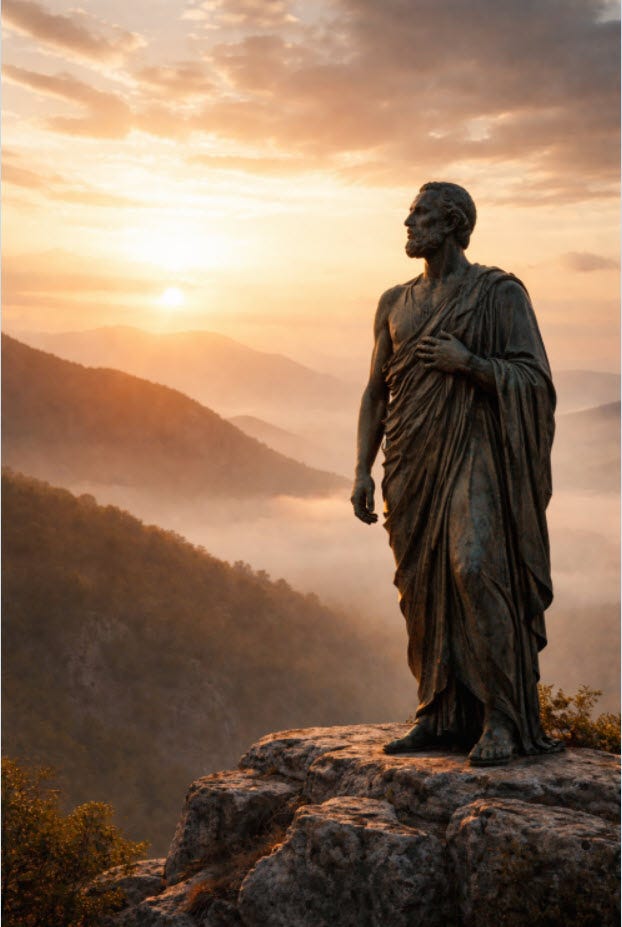
There seems to be a shallowness in modern spirituality where prayer has been reduced to a transaction. So many now approach the divine as if it were a reluctant merchant—one who might be persuaded, with enough sincerity or desperation, to alter the terms of reality in our favor.
The early Stoics rejected this entirely. They did not deny God. On the contrary, they affirmed something far more demanding: that the universe itself is divine—ordered by Logos, governed by reason, and unfolding through an unbreakable chain of cause and effect.
Stoic prayer is not an attempt to influence the cosmos. It is an exercise in aligning yourself with it. The Stoic does not kneel to ask for a different life. He stands upright to accept the life already given.
The Error of Petition
The common form of prayer assumes that external things are good or bad in themselves.
Health is good
Loss is bad
Success is good
Failure is bad
But Stoicism dismantles this framework at its root. The only true good is virtue—reason perfected and rightly applied. The only true evil is vice—the corruption of judgment.
Everything else—wealth, reputation, comfort, even the body itself—belongs to the realm of indifferents. This is not indifference as apathy, but indifference as classification. These things are not yours. They never were. And so, to pray for them is to ask for what does not belong to you.
Why Prayer and Meditation Exist at All
Stoicism is not merely an ethical system—it is a unified philosophical structure consisting of physics, logic, and ethics working together toward human flourishing .
Physics: The universe is governed by Logos (rational, providential order).
Logic: The mind must correctly interpret reality.
Ethics: The goal is to live in agreement with nature.
This matters because: Prayer and meditation only make sense within this system. If the cosmos is rational and determined, then: You do not pray to change fate. You train yourself to understand and accept it rightly.
What, Then, Is Stoic Prayer? Stoic prayer is not a request. It is a realignment.
“Lead me, Zeus, and thou, O Destiny, Whithersoever I am appointed to go; I will follow without wavering. Even if I am unwilling, I shall follow nonetheless.”— Cleanthes, Hymn to Zeus
There is no pleading here. No bargaining. No request for comfort, wealth, or escape. This is not the voice of a man trying to change the will of God—it is the voice of a man training his will to agree with it.
The Stoic stands before the order of the cosmos and says: Not “change this,” but “prepare me.” Not “remove this burden,” but “make me capable of carrying it well.”
This is why the great Stoic prayer—preserved in Cleanthes’ hymn—does not ask for fortune, safety, or relief. It asks for guidance in following what must already occur. This is prayer purified of illusion.
The Divine Within
The Stoics teach that each of us carries a fragment of the divine. Not metaphorically—but literally.
The human soul is pneuma—a rational, living breath that participates in the same Logos that governs the stars. To pray, then, is not to speak across a distance. It is to turn inward. It is to address the ruling faculty—the hegemonikon—and bring it back into harmony with the whole. When you pray as a Stoic, you are not informing God of your needs. You are reminding yourself of your nature.
“If God had entrusted an orphan to your care, would you have neglected him in such a fashion? Yet he has delivered you yourself into your own keeping, and says, ‘I had no one in whom I could put more confidence than you. Keep this person as he was born by nature to be; keep him modest, trustworthy, high-minded, unshakeable, free from passion, imperturbable.’” Discourses, Book II, Chapter 8
Meditation as a Discipline
If prayer is alignment, meditation is training.
The progressing Stoic does not wait for adversity to test his character.
He prepares.
Each day becomes an exercise:
To examine impressions before assenting
To distinguish what is in his control from what is not
To rehearse loss, hardship, and death—not morbidly, but truthfully
This is not pessimism. It is clarity. The Stoics understood that the mind is not disturbed by events, but by the judgments it forms about them. Meditation, then, is the forge in which those judgments are shaped.
Prosoche: The Guard at the Gate
At the center of Stoic practice lies one word: Prosoche — mindfulness attention. A constant vigilance over the inner life; this is a fundamental spiritual exercise.
Every impression that enters the mind is a kind of messenger. Some are truthful. Some are deceptive. The untrained person accepts them all without question.
The Stoic interrogates them.
“Is this within my control?”
“Is this truly good or bad?”
“What judgment am I about to endorse?”
Meditation sharpens this faculty. Prayer strengthens it. Together, they form the discipline of a free man.
The Transformation of Emotion
The Stoics do not aim to eliminate feeling. They aim to transform it.
Where others are ruled by fear, the Stoic cultivates caution.
Where others chase pleasure, he develops rational joy.
Where others are driven by craving, he forms rational wish (boulesis).
These are not suppressed emotions. They are corrected emotions—arising from true judgments about reality.
Prayer and meditation are two means by which this transformation occurs.
Embracing Fate
At the highest level, Stoic prayer culminates in a single disposition: Embrace fate. Not mere acceptance. Not reluctant endurance. But a willing embrace of everything that occurs. This is the hardest teaching of Stoicism. And the most liberating.
Marcus Aurelius makes the point in practical terms:
“Accept whatever comes to you woven in the pattern of your destiny…”— Meditations, Book 4.26
For when you no longer resist what must happen, you are no longer divided against reality. You become, in a very real sense, unconquerable.
A Closing Reflection
If you would pray as a Stoic, begin here:
Do not ask for an easier life.
Ask for a stronger faculty of judgment.
Do not ask for events to change.
Ask to see them clearly.
Do not ask for the removal of hardship.
Ask for the virtue to meet it well.
For the universe is not waiting to be persuaded. It is waiting for you to understand it.
Final Thought
Someone who harmonizes their desires with nature does not implore the world to transform; instead, they cultivate within themselves the qualities that render external changes unnecessary.