
The Stoic Opposition
A Dispatch for the End of an Era

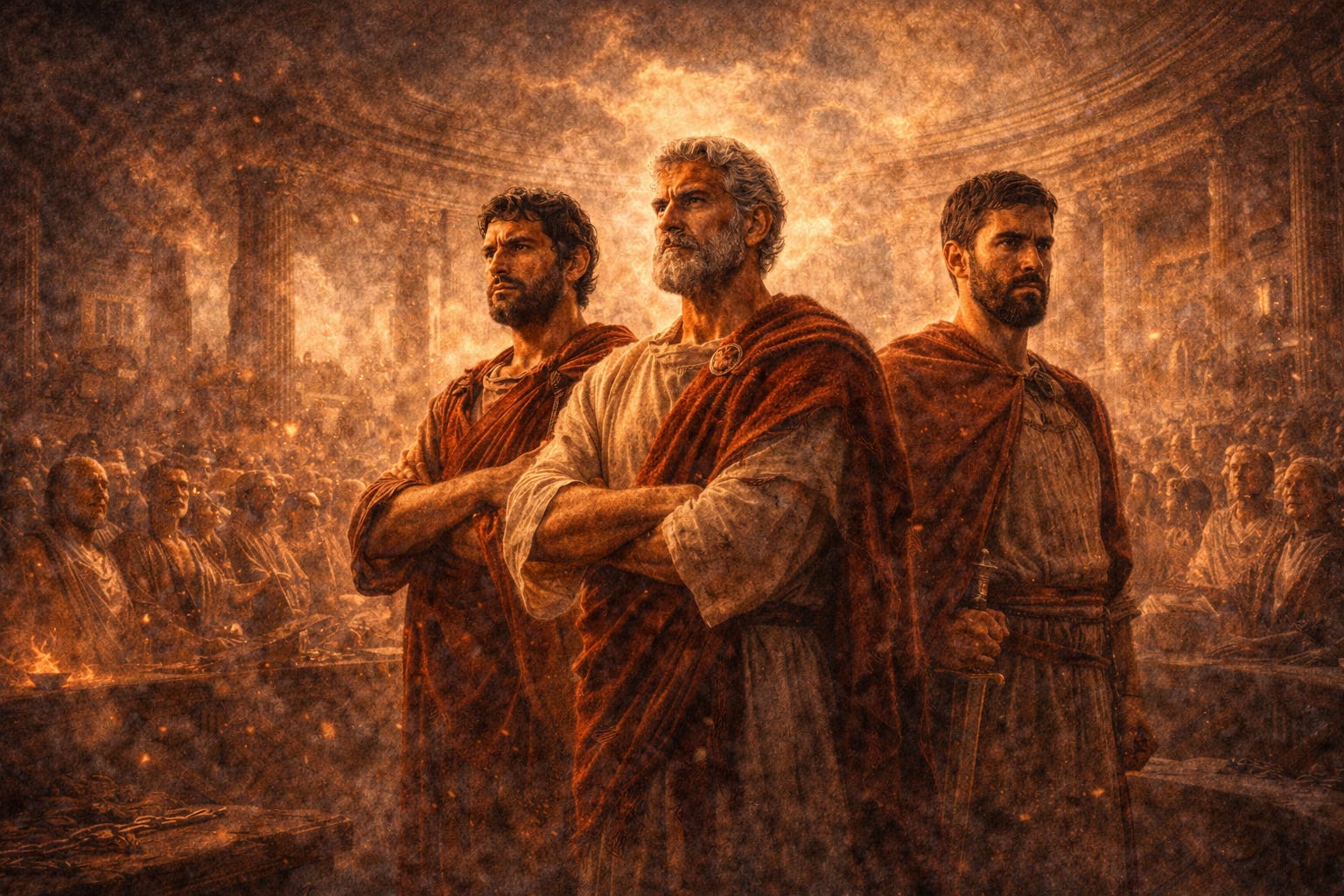
The Ghosts on the Senate Floor
In the first centuries of the Roman Empire, as the Republic’s charcoal embers were finally stomped into the dirt by autocratic boots, a handful of men refused to bend. They were not a “political party” in the modern sense—fickle, grasping, and hungry for the mob’s fleeting favor. They were individuals bound by a singular, iron creed: Virtue is the only true good. Remember the names that the dust of history has failed to bury, for they are your true ancestors. Cato the Younger, who watched the institutions he loved crumble and chose the blade over Caesar’s “mercy,” refusing to live in a world where a man’s freedom was a gift from a master. Thrasea Paetus, who stood and walked out of the Senate in a deafening silence while his peers tripped over their robes to flatter Nero. Helvidius Priscus, who looked imperial abuse in the eye and did not blink, even when the threat of the executioner’s cord was pressed against his throat.
These men lost their titles. They lost their ancestral lands. Most lost their lives. But they kept the only thing a tyrant cannot seize: their Prohairesis—their moral character. They understood a truth we have let slip through our soft, modern fingers: a man who fears nothing but his own dishonor is truly a sovereign, no matter who sits on the high throne.
The Inner Citadel Under Siege
I write to you now not as a partisan hack, nor as a man seeking the comfort of a “tribe.” I write as a Civis Romanus—a citizen of both this fragile Republic and the eternal Cosmic City. My first allegiance is to Virtue. My second allegiance is to my country’s Constitution. I owe no man, no party, and no cult of personality anything that sits above these two pillars.
We find ourselves in the second term of Donald Trump’s presidency. To the Stoic, the name on the door is less important than the state of the souls within the house. Today, the air is thick with the stench of factionalism; rhetoric burns hotter than reason, and the “Republic” feels increasingly like a stage-play—a ghost of the substance it was meant to be.
I plant my staff here. I am guided by the ancients who opposed the Caesars not from a place of petty, emotional hatred, but from a cold, clear sense of Duty (Officium). The first discipline of our opposition is to fortify the Inner Citadel. Epictetus, who carried the scars of a slave’s chains, reminds us: our judgments, our aims, and our power of assent are ours alone. The President’s late-night decrees, the screams of the news-hawkers, the policies of the bureaucracy—these are externals.
If you allow a political foe to rot your reason with anger, you have surrendered a territory they could never have conquered on their own. To be “outraged” is to admit that an external event has mastered your soul. I refuse to be mastered.
The Steady Hand, Not the Flailing Fist
Justice is not a suggestion or a “feeling”; it is a cardinal virtue, as structural to a man as his own skeleton. It demands we speak when the common good—the Res Publica—is threatened. But a Stoic’s speech is shaped by Wisdom, and his actions by Temperance.
Our opposition is not the flailing fist of a child in a tantrum; it is the steady hand of a trireme captain in a gale. If you condemn a lie, do not answer it with a distortion of your own. If you decry cruelty, do not become a brute in the process. As Seneca warned us, “No man can live happily who regards himself alone... we must live for others if we wish to live for ourselves.”
We are citizens twice over—of our nation and of the human race. This Cosmopolitanism is not a soft, borderless sentimentality. It is a rigorous standard. It compels us to weigh every policy not by whether it serves our “team,” but whether it serves the rational nature of humanity. When the vulnerable are mocked, when public trust is treated as a commodity to be traded, the Stoic does not merely “disagree.” He recognizes a violation of the Natural Law.
The Resistance of the Refusal
Like Musonius Rufus, who spoke the truth even in the isolation of exile, we must choose our battles with surgical care. Resistance in a decadent age does not always need to roar. Often, it is a calm, steadfast “No” when the world expects your compliance. It is a refusal to flatter the powerful, a refusal to excuse the inexcusable, and a refusal to barter your principles for a moment of professional safety or social standing.
In this administration, as in those of the Roman past, my resistance is threefold:
The Guard at the Gate: I will not chant slogans. Slogans are the death of thought. I will test every claim—whether from the White House or its loudest critics—against the measure of Reason.
The Execution of Duty: I will engage in the mechanics of citizenship—voting, writing, advocating—with the precision of a soldier cleaning his kit. These are the spheres within my control.
The Living Standard: If the public discourse is coarse, I will remain measured. If the age is dishonest, I will keep my word until it bleeds. If contempt divides neighbor from neighbor, I will be the bridge, not the match.
The Elder’s Verdict
There are those who will sneer and say this is “too little.” They want fire, fury, and the visceral rush of the mob. I tell them: Philosophy is the forge where fire is given a useful shape. Without the forge, the fire merely burns the house down.
The Stoic statesmen who resisted imperial tyranny within Rome did not win by the metrics of power. They “won” because they remained upright while the world knelt. They preserved the idea of a virtuous human being for future generations to find in the rubble.
The true measure of your life is not whether you prevail in the town square, but whether you keep your soul intact. What is a Republic without virtuous citizens? It is a hollow shell, waiting for the first strong wind to collapse it.
I do not know how this administration will end, nor do I know if the Republic will survive its own internal rot. Those outcomes lie in the realm of the “Indifferents.” What lies within my command is this: to think clearly, to act justly, and to speak with the courage of a man who has nothing left to lose but his honor. If I do these things, I have fulfilled my oath. Not as a partisan, but as a man.
The Week’s Meditation: The Gatekeeper of Assent
The Practice:
This week, treat your mind as a frontier fortress. The “news” is a series of messengers arriving at your gate. Most of them are bearing false reports or emotional bait designed to provoke a surrender of your tranquility.
The Action:
Before you allow yourself to feel “outraged,” “vindicated,” or “despairing,” stop the thought at the gate. Perform a mental audit. Ask yourself:
“Is the source of this emotion within my direct control?” “Does reacting with passion improve the common good, or merely exhaust my spirit?” If the event is an “external” (a policy change, a speech, a tweet), observe it as you would a thunderstorm—as a fact of nature that requires an umbrella, not an argument. Deny the thought entry into your inner citadel. Return your focus immediately to that which is in your power: your own work, your own family, and your own character. That is where the real Republic lives.
Thank you so much for taking the time to put your knowledge and values in writing to share. They are careful, powerful words indeed.
Thank you for such an insightful article, which, once again, establishes that virtue is the only good and how Cato the Younger and others like him didn't fall victim to the times. It is a great lesson for all of us living in these vicious times.